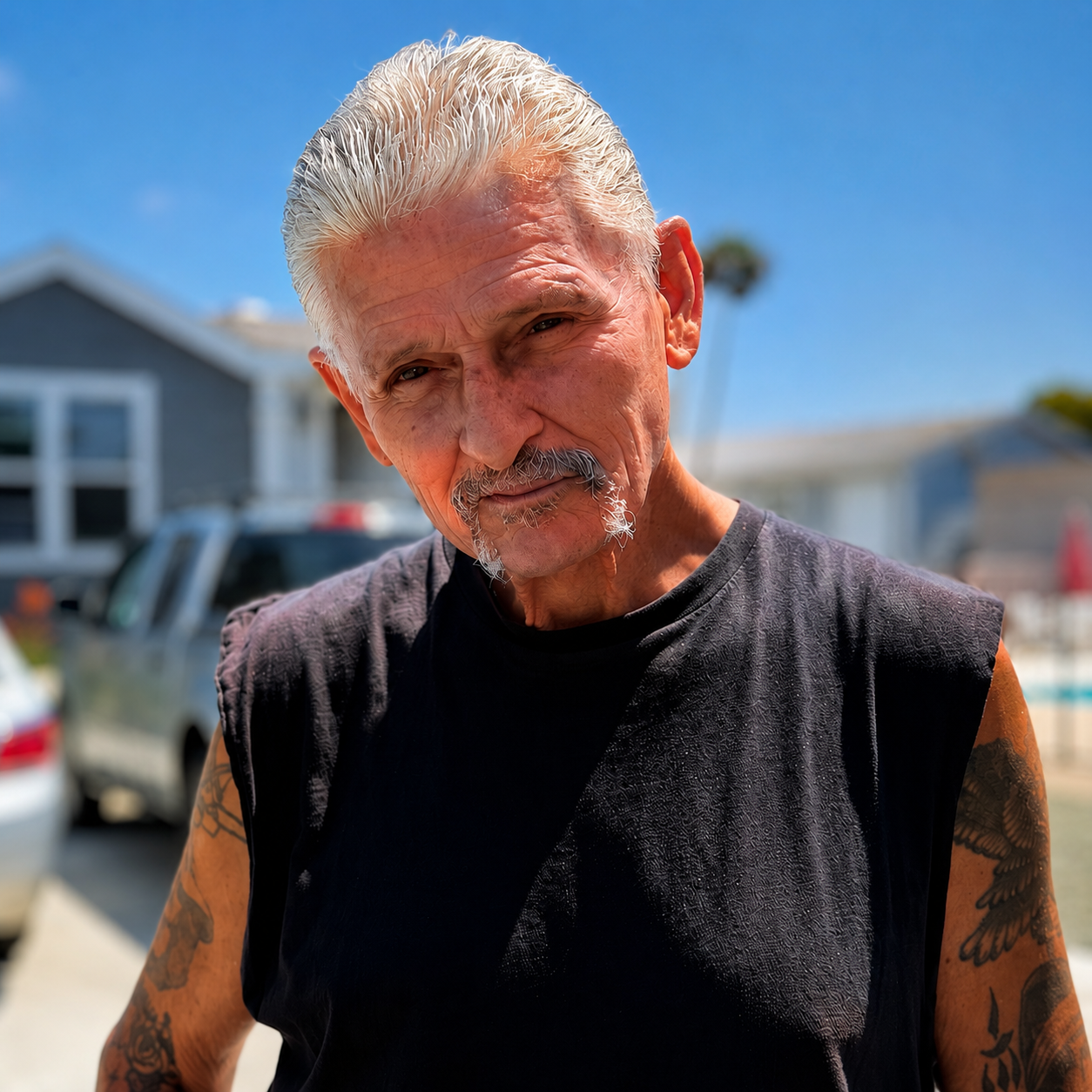
This is Billy.
"Don't fool yourself."
Billy's Story
Don't Fool Yourself
Billy never thought he would be the one who needed help.
Even a small, timely contribution can prevent something much harder to recover from.
The Photographs
If you walk into Billy's Santa Barbara home, one of the first things you notice is the photographs.
They're everywhere.
Parents. Children. Grandchildren. Brothers and sisters. Weddings. Childhood pictures. Generations of family.
To someone else, they might simply look like old photographs.
To Billy, they're his life.
They're also part of a Santa Barbara story that stretches back generations.
Six Generations of Santa Barbara
Billy was born and raised here. He estimates his family has called the Santa Barbara area home for about six generations.
His childhood memories are filled with the Santa Barbara many longtime residents remember.
His mother would drop Billy and his brothers and sisters at the beach in the morning, and they would stay until afternoon. They learned to swim young. His dad taught them to surf. They camped in the Sierras, fished, water-skied and spent time surrounded by aunts, uncles, grandparents and cousins.
Billy remembers making homemade crab traps out of bicycle rims, finding whatever they could use for bait, and taking them out into the ocean.
They didn't have to create reasons to be together.
They simply were.
Family was life.
His roots here run deep.
Billy's mother was born and raised in the Santa Barbara area and would eventually become the owner of The Mecca on Milpas Street.
Billy's father served in the Korean War and later operated a Texaco gas station.
As a little boy, Billy would go to the station after school and stay until his father came home at night. That's where he learned to work on cars.
He remembers his dad putting him under the hood and teaching him how to change spark plugs and perform tune-ups. Billy says that by about seven years old, he already knew his way around an engine.
His father was Bill. Billy was Bill Jr. Eventually, his dad decided having two Bills answering every time someone called the name wasn't going to work. His dad would be Bill. His son would be Billy. And Billy he has been ever since.
More Than a Roof
The home Billy is fighting to keep is part of that history too.
Years ago, when his mother owned The Mecca, she purchased a mobile home only a few blocks away. After closing the bar at two or three in the morning, it gave her somewhere nearby to go rather than making the longer drive home. Eventually, she moved into it.
Today, Billy lives in that same home.
Look around and you'll see decades of his family's history on its walls.
It's more than a roof.
It's where his mother lived. It's where memories were made. It's one of the pieces of his family's Santa Barbara history that remains.
And today, Billy is fighting to keep it.
Then 2026 Changed Everything
For approximately three years, Billy centered much of his life around caring for his mother.
When she became seriously ill with cancer and doctors told the family she had about six months to live, Billy wasn't thinking about what would happen to his finances afterward. He was thinking about his mom.
He stayed close because he didn't want her to fall or have something happen while nobody was there. He tried to keep her comfortable. He tried to keep her happy.
"I gotta do everything I could just to keep her happy."
Billy remembers the day before she died. She called people she loved and said goodbye.
On January 15, 2026, Billy lost his mom.
When he talks about her now, the words become much simpler.
“I just miss her.”
Loss Upon Loss
Then, less than six months later, on July 3, Billy's son died.
And in August, another loss came. One of Billy's closest cousins passed away.
A mother. A son. A cousin. All within months.
There wasn't much time to recover from one loss before another arrived.
And underneath all that grief, another crisis was quietly developing.
Two Incomes to One
Billy went from two incomes to one.
Before his mother's death, Billy and his mother combined their money to maintain their household. They weren't living extravagantly. But the bills got paid. There was food. If something needed to be handled, they handled it.
Then his mother died, and her income stopped. The expenses didn't.
Billy started cutting everything he could. Internet went. He reduced his phone expenses. He eliminated services. He bought less.
And eventually, he started reaching the end of the month wondering what he was going to eat.
Still, Billy didn't want to call his brothers and tell them he couldn't make it. He didn't want them worrying about him. He was accustomed to figuring things out himself. So he kept trying.
The Metal Detector
Then he sold his metal detector.
It may sound like a small thing. To Billy, it wasn't.
He loved that metal detector. He still talks about how much he misses it and wishes he had it back.
But Billy needed food. So he sold it.
Not because he stopped enjoying something he loved.
Because he needed to eat.
What Financial Instability Actually Looks Like
That is what financial instability can actually look like.
It doesn't always begin with someone sleeping outside. Sometimes it begins quietly.
Cancel the internet. Lower the phone bill. Put off one expense. Then another. Sell something you love. Figure out which bill can wait five more days. Hope something comes through before the next one is due.
Billy says he's been making those calculations for months.
If I Had to Walk
Then his car needed work before it could pass smog. The repair was approximately $700. Then came registration.
For roughly two months, Billy couldn't use his vehicle because he couldn't afford to get everything handled.
His response?
“If I had to walk, well, let it be.”
Something New
On the day we interviewed Billy, he had just returned from Catholic Charities, where he had gone for food.
That was new for him too.
“I've never done that before. But that's what I have to do right now.”
The Frustration
When we asked Billy what the hardest part of trying to make ends meet has been, he didn't say hunger. He didn't say the bills. He said:
“The frustration.”
Because Billy has always been someone who figures things out. Someone who helps. Someone who makes things happen.
And suddenly, no matter how hard he tried, there wasn't enough to make everything happen at once.
You Can Have Everything and Have Nothing
Billy has seen how quickly someone can lose everything.
Years ago, Billy knew a man who owned a trucking business. The man's wife handled much of the business side while he drove. Then she died. Her husband didn't know how to manage everything she had handled. Paperwork began to pile up. Problems compounded. The business eventually failed.
One day, Billy encountered the man again. He was living on the street.
Billy couldn't believe it. A man who had owned a business had lost everything.
That memory stayed with him. Today, it means something different.
Billy understands just how thin the line can become between having a home and losing one. As he put it:
“You can have everything and have nothing.”
Don't Fool Yourself
That's also why Billy says he doesn't judge people when he sees them struggling. Because now he knows.
When we asked what he would tell someone who looks at his situation and thinks: "That could never happen to me." Billy's answer was immediate.
“Don't fool yourself.”
Two words.
But they may be the most important words in his story.
Billy Almost Became Another Person Reached Too Late
Instead, someone noticed what was happening before he lost his home.
A woman in Billy's community knew about his situation. She told him about a man named Al and an organization called Everything Under The Sun Son that was helping people who were at risk of losing their homes.
Billy called.
By then, his biggest fear wasn't losing internet. It wasn't his car. It wasn't even having to ask for food. It was losing his home.
He was receiving information that made him believe he might have to leave.
His mother had just died. His son had just died. And now Billy thought he might lose the home carrying so much of his family's history.
When we asked where he thought he might be today if he hadn't connected with EUTSS, Billy's answer was sobering: Probably packing his things.
This is exactly the moment EUTSS was created for.
Not after Billy lost his home.
Before.
Before someone's belongings are packed.
Before the family photographs come off the walls.
Before housing instability becomes homelessness.
Before a temporary financial crisis becomes something much harder and more expensive to reverse.
What Billy Wants
Billy isn't asking someone else to build his life for him. He wants the opportunity to stabilize the life he already has.
He wants to keep his home. He wants to catch up. He wants to be able to buy groceries without wondering which bill won't get paid. He wants his car working and registered.
And when we asked Billy what he hopes life looks like a year from now, his answer wasn't extravagant. He wants to be able to get in his car and drive to see his daughters. Right now, they have to come to him. He wants to be able to go to them.
Again and again, Billy's story comes back to family. And somehow, it still comes back to helping other people.
Makes You Want to Help Back
Billy told us that throughout his life, he's been someone who helped others. Now he's learning how difficult it can be to be the person on the other side of that equation.
When we asked what it feels like knowing people in his community care enough to help him, he said:
“Makes you want to help back.”
That may tell you more about Billy than anything else in this story. Even while he's struggling, he's thinking about what he can give back.
At the end of our conversation, he told us: "If there's anything I could do, please let me know. If I could do it, I'll do it. If I can't, well, I'll let you know."
That's Billy. Real. Unpolished. Grateful. And still looking for a way to contribute.
Why EUTSS Matters
We asked Billy one final question. Why does an organization like EUTSS matter? Billy answered it better than we could:
“If they can stop one person from losing their home or losing who they are, that's what's important.”
Not just losing a house. Losing who they are.
That's what prevention protects.
A person's home. Their history. Their connection to community. Their independence. Their dignity. Their sense of themselves.
Let's Go Drink a Pepsi
And when we asked what Billy would say to someone who gave $10, $25, $50, bought groceries or helped cover one of his bills, we expected a thank-you. Billy had a better answer.
“Let's go drink a Pepsi.”
Because Billy doesn't want to be somebody's charity case. He wants to be somebody's neighbor. Maybe even their friend.
There Are People That Still Care
And that's ultimately what Billy wants people to understand. There are still people who care. Sometimes they simply don't know someone is struggling.
Because, as Billy reminded us, people like him aren't walking around announcing: "I'm about to lose my place."
Sometimes somebody has to notice. Somebody has to ask. Somebody has to care early enough to make a difference.
Billy ended our conversation with this:
“There are people that still care in this life.”
We believe that too.
And maybe rebuilding community begins by proving him right.
Billy's story is shared with permission.
Help Someone Before Crisis Becomes Homelessness
Billy's story is why prevention matters. Sometimes timely help with groceries, transportation, utilities, or an unexpected expense can help someone remain stable while they regain their footing.
One person. One dollar. One community looking out for one another.
Join The $1 Million People Challenge
